The Alankrit Srivastava Blog

www.alankrit.net

  • Day 25 — How Can a Crypto Treasury Avoid One Dangerous Key?

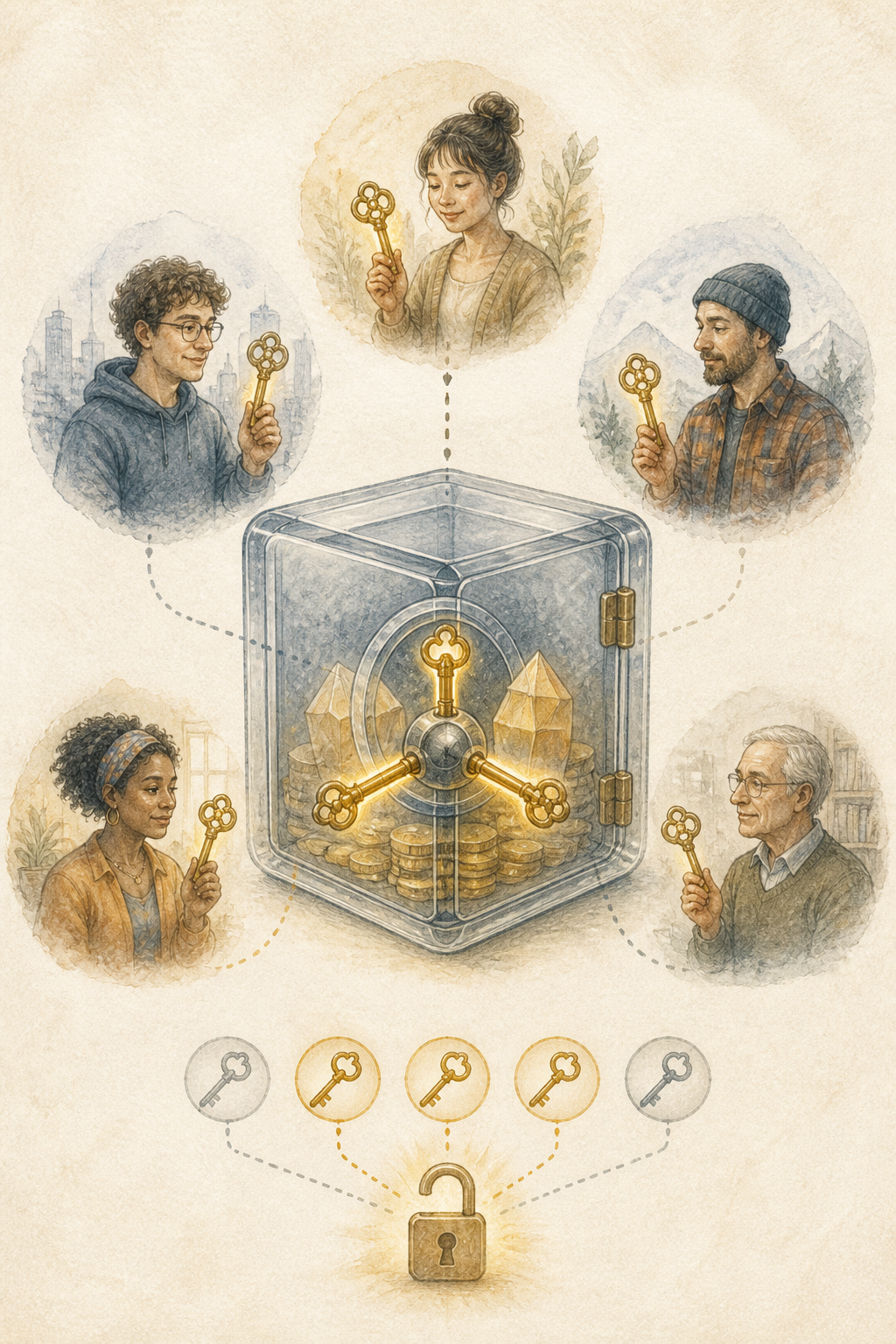
    Watercolor illustration of several trusted signers jointly unlocking a multisignature crypto treasury

    Why a crypto treasury needs shared control

    A crypto treasury can hold serious value. Therefore, one private key should not control everything.

    If that one key is lost, stolen, or used badly, the whole treasury can be at risk.

    This is why teams often use a multisig, also called a multisignature wallet.

    What a multisig does

    A multisig wallet requires more than one approval before funds can move.

    For example, a two-of-three setup has three signers. Any two must approve a transaction.

    As a result, one compromised key is not enough to empty the treasury.

    Why this matters for DAOs

    Many DAOs and crypto teams use treasuries to pay contributors, fund projects, and manage reserves.

    A shared treasury needs clear rules. It also needs signers who understand their responsibility.

    Good treasury security is not only about tools. It is also about process.

    The human side of key management

    Signers should store keys safely. They should also avoid approving transactions they do not understand.

    In addition, teams should decide what happens if a signer leaves, loses access, or becomes inactive.

    The takeaway

    A crypto treasury should avoid depending on one dangerous key.

    A multisig spreads control, reduces single-point failure, and makes treasury decisions easier to review.


  • Day 24 — Can an Online Community Run an Organisation?

    Watercolor illustration of a DAO community voting on proposals around a shared treasury

    A decentralised autonomous organisation, or DAO, is an attempt to coordinate people and shared resources using blockchain-based rules. Instead of every decision being made by a traditional management hierarchy, members can create proposals, vote, and direct a treasury through smart contracts.

    Many DAOs use governance tokens. A holder may vote on protocol fees, upgrades, grants, or which assets a treasury should hold. Proposals often move through discussion, a formal vote, and then execution. Some systems execute successful votes automatically; others rely on a committee or multisignature wallet.

    The word autonomous can be overstated. Writing proposals, evaluating trade-offs, maintaining software, and negotiating partnerships remain human work. Smart contracts can enforce a voting process and treasury rule, but they cannot decide what a community should value.

    Token voting also does not guarantee equal power. Wealthy holders, founders, investors, or exchanges may control a large share of votes. Participation is often low, so a small organised group can outweigh thousands of passive members. Delegation helps people assign their votes to informed representatives, while creating its own centres of influence.

    Governance has technical risks as well. Attackers may borrow voting power, exploit poorly written execution code, or rush harmful proposals through inattentive communities. Sensible systems use proposal thresholds, voting delays, timelocks, transparent delegates, and emergency procedures, though every safeguard adds friction or trust.

    A strong DAO is therefore more than a token and a chat group. It needs clear scope, reliable information, accountable contributors, conflict resolution, and a treasury process people can audit. The blockchain records decisions; community culture determines whether those decisions are thoughtful.

    Large treasuries rarely let one person hold the only key. Tomorrow, on Day 25, we will close this first arc with the multisignature wallet—a simple tool for turning shared responsibility into an enforceable rule.

  • Day 23 — Where Does Crypto Yield Actually Come From?

    Watercolor illustration tracing crypto yield back to borrowers, trading fees, staking, and token rewards

    Crypto yield means the return a user earns from putting crypto assets to work. Before chasing a high number, compare this idea with DeFi loan liquidation and with the wider Ethereum DeFi overview.

    A dashboard may promise five, twenty, or even one hundred percent annual yield, but the percentage is the last part of the story. The first question should be: who is paying, and what useful activity produces the return?

    In a lending market, yield can come from interest paid by borrowers. In a liquidity pool, it can come from fees paid by traders. Proof-of-stake networks reward validators for helping secure and operate the chain, and some of those rewards can flow to people who delegate or stake assets.

    Protocols also distribute newly created tokens to attract users. These incentives can bootstrap a market, but they are not the same as durable revenue. If everyone earns a token only to sell it, and there is no continuing demand for it, the displayed yield may collapse along with the token price.

    Annual percentage yield often assumes rewards are reinvested and the current rate continues for a full year. Both assumptions can be unrealistic. Rates change with utilisation, trading volume, token emissions, and market prices. A high APY can disappear within hours while the underlying asset falls much faster.

    Yield is compensation for something: lending risk, market-making risk, price volatility, lock-up, validator penalties, smart-contract exposure, or simple token dilution. If the source cannot be explained clearly, the return may be circular—paid mainly from new deposits or newly printed incentives rather than productive demand.

    A useful review separates rewards by source, values them in a stable unit, checks withdrawal conditions, and tests what happens if the reward token drops sharply. It also includes gas, slippage, taxes, and impermanent loss instead of focusing only on the largest number on the screen.

    Many yield protocols can change parameters or direct a treasury through community voting. Tomorrow we will look at the organisation behind that process: the DAO, and how decentralised its decisions really are.

    Why this matters

    In simple terms, crypto yield is not free money. It usually comes from fees, borrowers, rewards, or risk that someone else is willing to take.

    What to remember

    Therefore, a useful yield question is not only how high the return looks. Ask where the return comes from, who pays it, and what can break.

  • Day 22 — What Happens When a DeFi Loan Becomes Unsafe?

    Watercolor illustration of a DeFi loan health meter triggering collateral liquidation

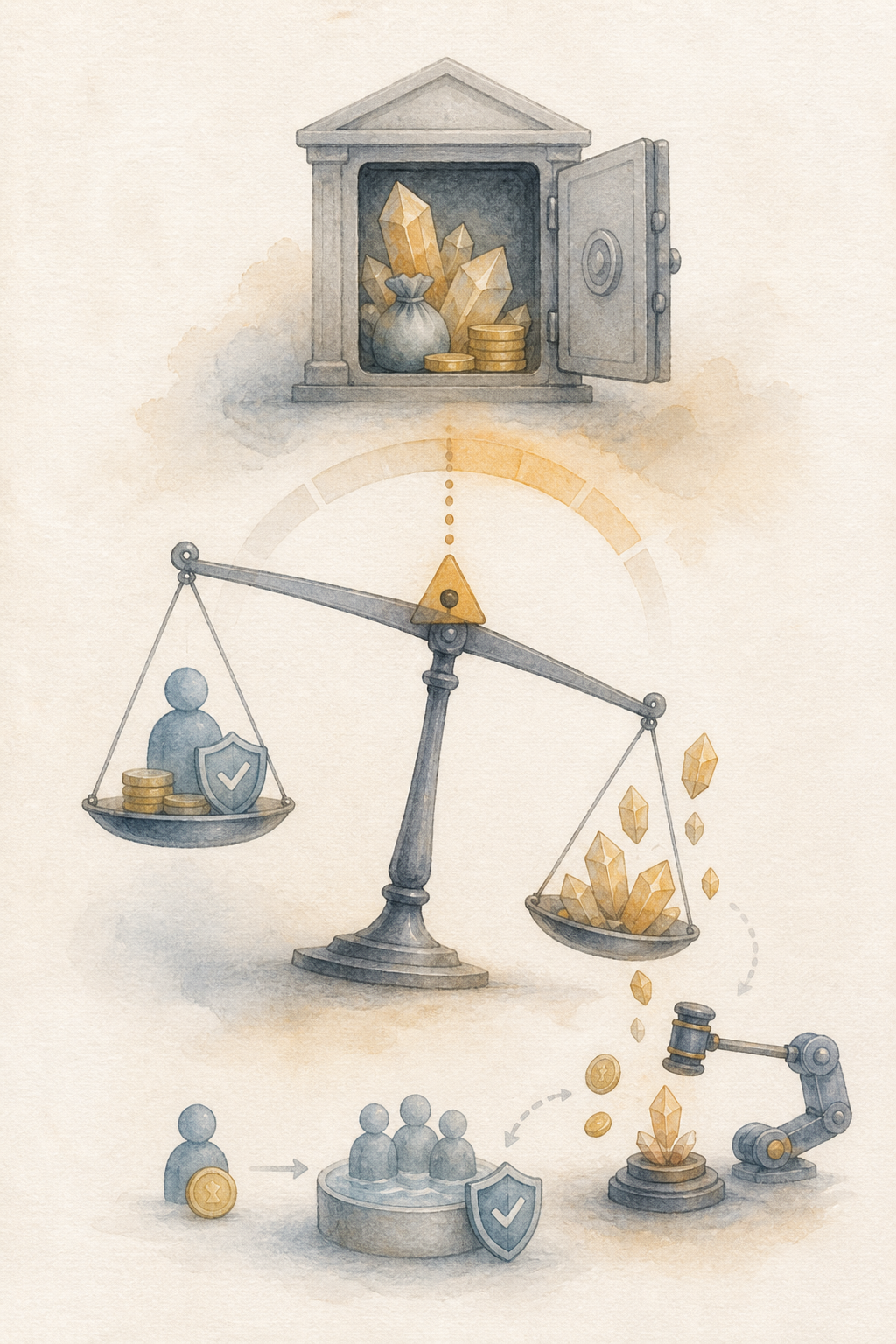
    A DeFi loan begins with more collateral value than debt, but crypto prices can move quickly. If the collateral falls far enough, the protocol cannot wait for a human conversation or a monthly payment. Its smart contracts enforce a liquidation rule.

    Each market defines a threshold that determines how much borrowing a particular asset can support. Interfaces may summarise the buffer as a health factor. A comfortable value means the collateral can absorb some decline; a value near the limit means even a small price move may make the position eligible for liquidation.

    When the threshold is crossed, an independent liquidator can repay part of the borrower’s debt and receive some collateral, usually with a bonus. That reward motivates bots to act quickly. The protocol reduces risky debt, lenders remain better protected, and the borrower loses collateral plus a penalty.

    Consider ether collateral worth $1,500 against an $800 loan. If ether falls and the permitted borrowing limit drops below the debt, liquidation can begin. Adding collateral or repaying part of the loan before that point restores the safety margin. Watching only the original deposit price is not enough because the relevant values update continuously.

    Liquidation depends heavily on price oracles. A delayed or manipulated price can liquidate healthy users or leave the protocol with bad debt. Network congestion also matters: when many positions fail together, gas costs rise and liquidators may struggle to process them quickly.

    Borrowers can reduce risk by using less leverage, choosing strong collateral, maintaining a wide buffer, monitoring alerts, and understanding the exact threshold and penalty. There is no universal safe ratio because volatility, oracle design, and protocol rules differ.

    Liquidations show that attractive borrowing and lending rates come from a system of incentives and risk controls. Tomorrow we will ask the broader question behind every advertised return: where does crypto yield actually come from?

  • Day 21 — How Can DeFi Lend Money Without a Credit Score?

    Watercolor illustration of borrowers and lenders connected through an overcollateralized DeFi lending pool

    A bank can evaluate salary, identity, and repayment history before making a loan. A public blockchain usually does not know those facts. DeFi lending therefore relies on a different protection: borrowers commonly lock collateral worth more than the amount they borrow.

    Lenders deposit assets into a smart-contract pool. Borrowers draw from that shared pool after supplying acceptable collateral. The protocol records deposits, debts, interest, and collateral ratios on-chain, while its rules apply equally to any wallet that can submit a valid transaction.

    Imagine depositing ether worth $1,500 and borrowing $800 in stablecoins. You still benefit if ether rises, and you gain spendable stablecoins without selling it. But if ether falls, the safety margin shrinks. Borrowing the maximum allowed amount leaves very little room for market movement.

    Interest rates are often driven by utilisation. When most of a pool is available, borrowing can be cheap. As more assets are borrowed and liquidity becomes scarce, rates rise to encourage repayment and attract new deposits. The exact curve is code defined by each protocol.

    This system makes loans fast and transparent, but it is not unsecured credit. Overcollateralisation protects lenders precisely because the protocol cannot chase an anonymous borrower later. It also means borrowers already need valuable assets, so DeFi lending does not solve every financial access problem.

    Depositors face risks too: smart-contract bugs, bad collateral, oracle failures, governance changes, and periods when withdrawals are constrained because too much of the pool is borrowed. A displayed supply rate can change rapidly and is not the same as a guaranteed bank deposit.

    If collateral can fall below the safe level, the protocol needs a way to act before the loan becomes undercollateralised. Tomorrow we will examine liquidation—the automatic process that protects the pool but can be painful for borrowers.

  • Day 20 — Why Would Anyone Put Their Tokens Into a Liquidity Pool?

    Watercolor illustration of liquidity providers adding a pair of tokens to a shared trading pool

    A liquidity pool is a shared pile of tokens that lets DeFi users trade without waiting for a buyer or seller. For context, compare it with automated market makers and the Ethereum DeFi overview.

    An automated market maker cannot serve traders with an empty pool. The assets are supplied by liquidity providers, often called LPs. They deposit a pair of tokens into a smart contract so other people can swap between them.

    Suppose a pool holds ether and a stablecoin. A provider contributes both assets at the pool’s current value ratio and receives a token or accounting record representing a percentage of the pool. If the provider owns one percent of the pool, that claim grows or shrinks with the pool’s reserves.

    How the pool helps traders

    Every swap usually pays a small fee. The fee remains in the pool or is distributed according to the protocol’s design, giving LPs a reason to provide capital. More liquidity also benefits traders by reducing slippage, so a healthy market tries to balance useful depth with a fair return for providers.

    The catch is that the pool constantly rebalances the two assets as prices move. If ether rises sharply, arbitrage traders remove ether from the pool and add stablecoins until the pool matches the outside price. The LP ends up holding less of the asset that rose and more of the asset that lagged.

    Compared with simply holding both tokens, this difference is called impermanent loss. The name can be misleading: if the provider withdraws while prices are far apart, the loss relative to holding becomes real. Trading fees may offset it, but they are not guaranteed to do so.

    What providers earn

    LPs also face smart-contract bugs, malicious tokens, oracle or bridge failures in some designs, and the possibility that an incentive token loses value. A high advertised annual return says little unless we know the trading volume, fee income, price risk, and source of extra rewards.

    Liquidity provision turns passive assets into market infrastructure, with rewards tied to real risks. Another kind of pool uses deposits not for swaps but for loans. Tomorrow we will see how lending can work without a bank checking your credit score.

    Why this matters

    In practice, a liquidity pool turns idle tokens into market infrastructure. Traders get instant swaps, while providers earn fees and accept market risk.

    What to remember

    Therefore, the pool is useful only when you understand both sides. Look at fees, token volatility, and impermanent loss before adding funds.

  • Day 19 — How Can You Trade Without an Order Book?

    Watercolor illustration of an automated market maker balancing two token reserves in a liquidity pool

    Trading without an order book

    An automated market maker, or AMM, lets people trade crypto without a traditional order book.

    Instead of matching buyers with sellers, an AMM uses a liquidity pool and a pricing formula.

    This is one reason decentralized exchanges can run directly on blockchains.

    What a liquidity pool is

    A liquidity pool holds two or more tokens inside a smart contract.

    Users called liquidity providers deposit tokens into the pool. In return, they may earn trading fees.

    When someone swaps tokens, they trade against the pool rather than another person.

    How the price changes

    Many basic AMMs use a simple idea often written as x*y=k.

    If a trader removes one token from the pool, the pool charges more of the other token.

    Therefore, large trades can move the price more. This effect is called slippage.

    Why arbitrage matters

    AMM prices can drift away from prices on other markets.

    Arbitrage traders notice the gap. Then they trade until the AMM price comes closer to the wider market.

    The takeaway

    An automated market maker turns a smart contract into a simple trading venue.

    It is open and useful, but traders still need to understand liquidity, slippage, and smart contract risk.

  • Day 18 — What Is DeFi If There Is No Bank Behind It?

    Watercolor illustration of open financial services connected through decentralized smart contracts

    What decentralized finance means

    Decentralized finance, or DeFi, uses smart contracts to build financial tools on public blockchains.

    Traditional finance depends on banks, brokers, and payment companies. Decentralized finance depends on wallets, tokens, contracts, and open networks.

    The goal is not to remove every human. Instead, the goal is to make core rules more open and programmable.

    What DeFi apps can do

    A DeFi app may let users swap tokens, lend assets, borrow against collateral, or supply liquidity.

    These actions happen through smart contracts. The contracts hold assets and follow predefined rules.

    Because the rules are on-chain, users can often inspect how the system works.

    Why wallets matter

    In decentralized finance, a wallet is the user’s account.

    The wallet signs actions and connects to applications. This gives users direct control.

    However, direct control also means mistakes can be expensive.

    The main risks

    DeFi has smart contract risk, market risk, oracle risk, liquidity risk, and user-error risk.

    For example, approving a bad contract can put funds at risk.

    Therefore, open access does not mean automatic safety.

    The takeaway

    Decentralized finance is finance built with blockchain-based rules.

    It can be open and powerful, but it must be used carefully.

  • Day 17 — What Keeps a Stablecoin Stable?

    Watercolor illustration of a stablecoin balancing different forms of collateral around a price peg

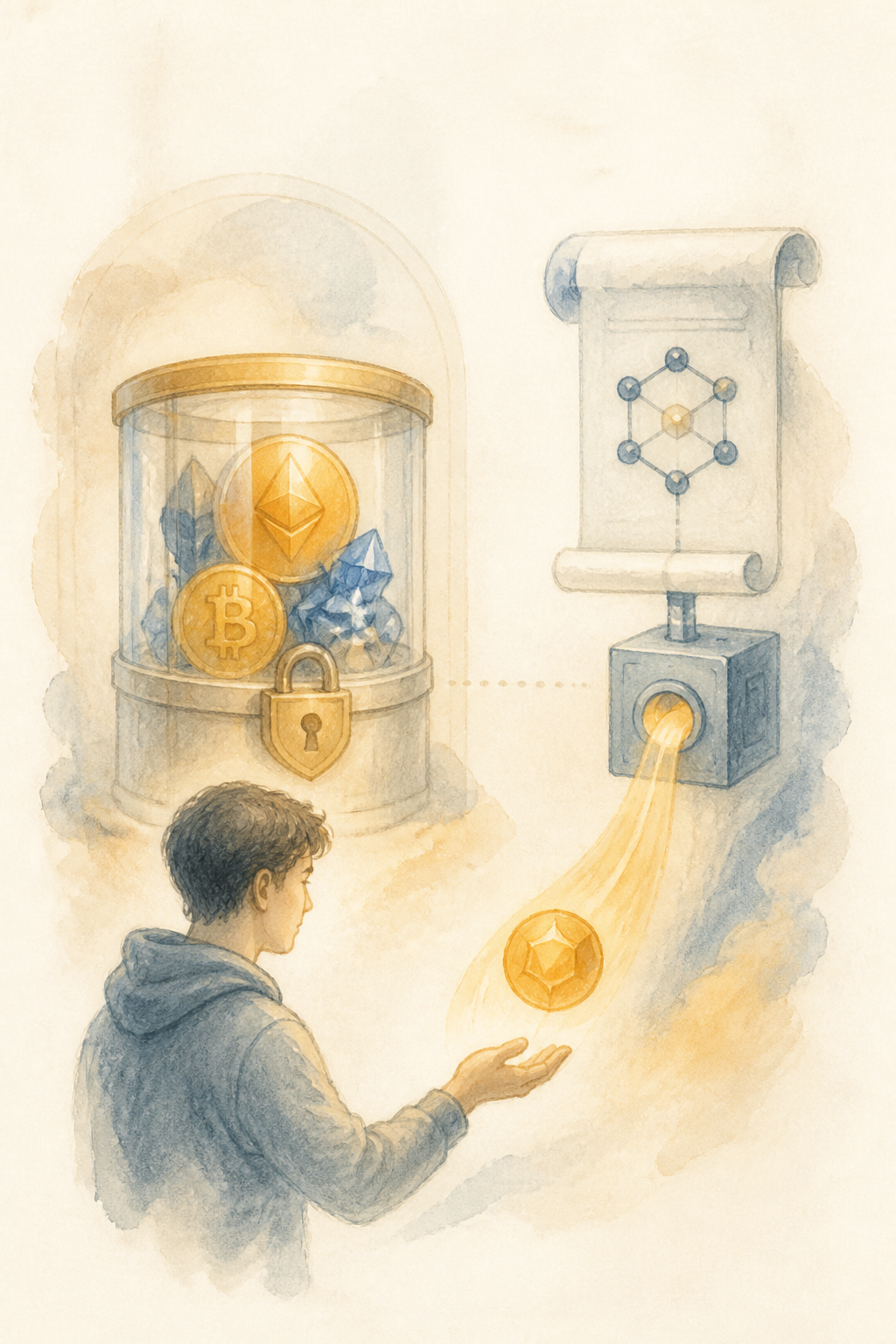
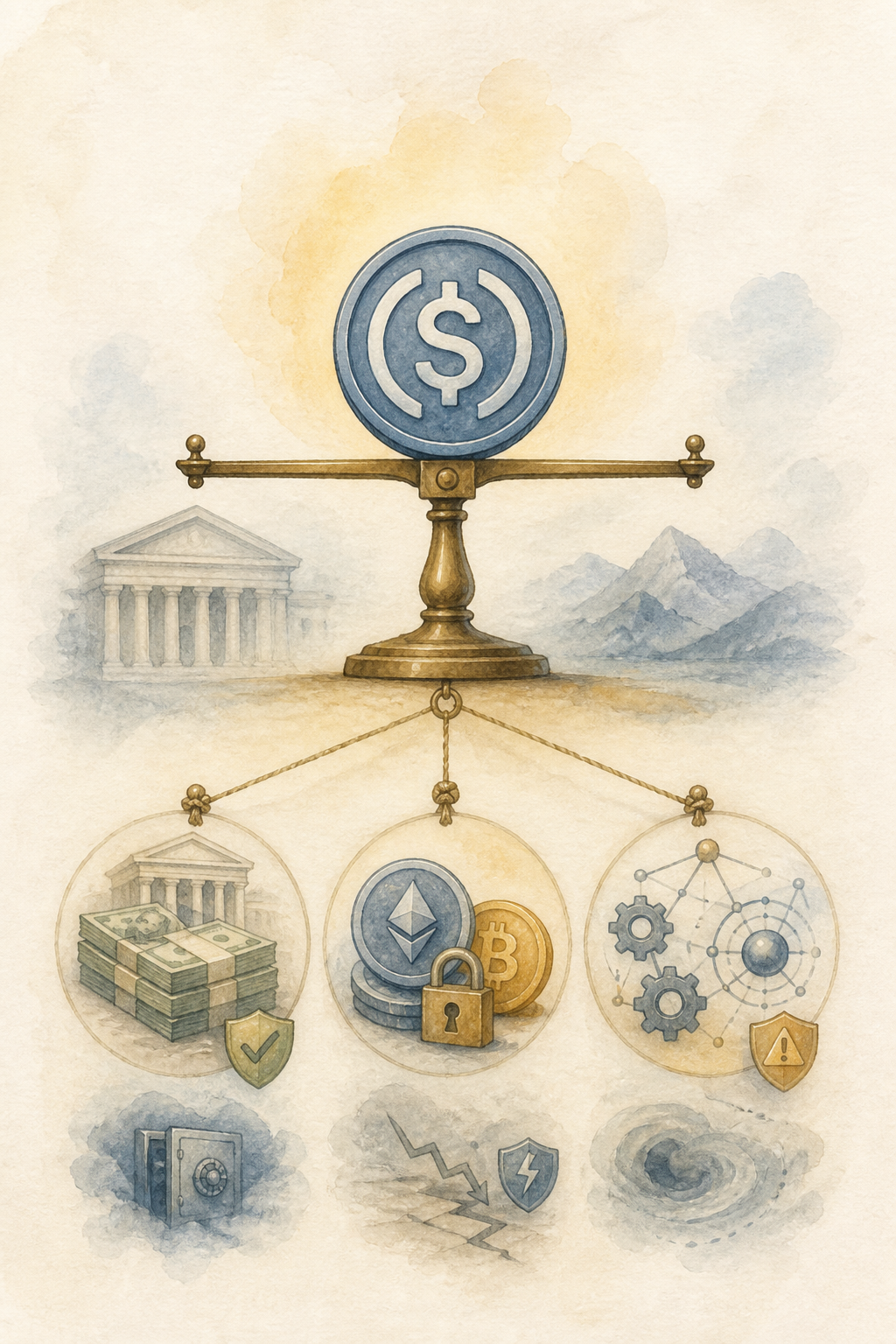
    Why stablecoins exist

    A stablecoin is a crypto asset that tries to hold a steady price. Most stablecoins target one US dollar.

    This is useful because bitcoin and ether can move sharply. A stable unit makes payments, trading, and DeFi accounting easier.

    However, stable does not mean risk-free. It means the token has a mechanism that tries to defend its peg.

    Fiat-backed stablecoins

    Some stablecoins are backed by cash, treasury bills, or similar assets held by a company.

    In the ideal case, one token can be redeemed for one dollar. That promise helps the market price stay close to the peg.

    Still, users must trust the issuer, the reserves, and the reporting process.

    Crypto-backed stablecoins

    Other stablecoins use crypto collateral. Because crypto prices move quickly, they often require extra collateral.

    For example, a user may lock more value than they borrow. If the collateral falls too much, the system can liquidate it.

    This design is more transparent, but it can still fail during sharp market moves.

    Algorithmic designs

    Some stablecoins try to hold a peg through incentives and supply changes. These are often called algorithmic stablecoins.

    They can be fragile. If confidence breaks, the peg can break too.

    The takeaway

    A stablecoin stays stable only if its backing, incentives, and market trust keep working.

    Therefore, always ask what supports the peg before trusting the name.

  • Day 16 — How Can a Blockchain Know What Happened Outside It?

    Watercolor illustration of an oracle bridge carrying real-world data onto a blockchain

    Why blockchains need oracles

    A blockchain oracle brings outside information to a blockchain. Smart contracts need this because they cannot freely browse the web.

    That limitation is intentional. Every node must be able to reach the same result.

    If each node fetched a website on its own, the answers could differ. Then the network could not agree.

    The oracle problem

    Smart contracts can verify on-chain data easily. However, real-world facts live outside the chain.

    For example, a lending app may need the price of ether. A prediction market may need a sports result. An insurance contract may need weather data.

    An oracle delivers that information in a form the contract can use.

    Why trust still matters

    An oracle can become a weak point. If it reports a bad price, a contract may make a bad decision.

    Because of that, many oracle systems use several data sources. Some also use multiple operators.

    This reduces risk, but it does not remove risk completely.

    A simple example

    Imagine a smart contract that lends stablecoins against ether. It must know the current ether price.

    The oracle supplies that price. Then the contract can decide whether a loan is safe.

    The takeaway

    A blockchain oracle is a bridge between on-chain code and outside facts. It is useful, but it must be designed carefully.

Built with ❤️ by Alankrit Srivastava