
Tag: bitcoin network

  • Day 7 — If a Few People Control Mining, Is Bitcoin Still Decentralized?

    What decentralization really means

    Bitcoin decentralization is not controlled by one single group. Miners matter, but they are not the whole story.

    Bitcoin also depends on nodes, users, developers, wallets, exchanges, and businesses. Each group plays a different role.

    So the better question is not whether Bitcoin is decentralized. The better question is which part of Bitcoin we are discussing.

    Miners have power, but not all power

    Miners create candidate blocks. They choose which valid transactions to include. They also compete for rewards.

    However, miners cannot simply change Bitcoin’s rules by themselves. If they create invalid blocks, nodes can reject them.

    This creates an important balance. Miners provide security, but nodes enforce validity.

    Why mining pools raise concerns

    Mining is expensive. Because of that, many miners join pools to make rewards more predictable.

    That can create visible concentration. A few pools may appear to control a large share of the hash rate.

    Still, a pool is not the same as one miner. Individual miners can leave a pool if it behaves badly.

    What a 51 percent attack means

    If one group controls most mining power, it could try to reorder recent transactions. It might also attempt double spending.

    However, it could not create coins from nothing. It also could not steal coins without valid signatures.

    Therefore, the risk is serious, but it has limits.

    The takeaway

    Bitcoin decentralization is a moving balance. Mining power, node rules, user choice, and economic incentives all matter.

    That is why decentralization is not a simple label. It is a system that must keep resisting control over time.
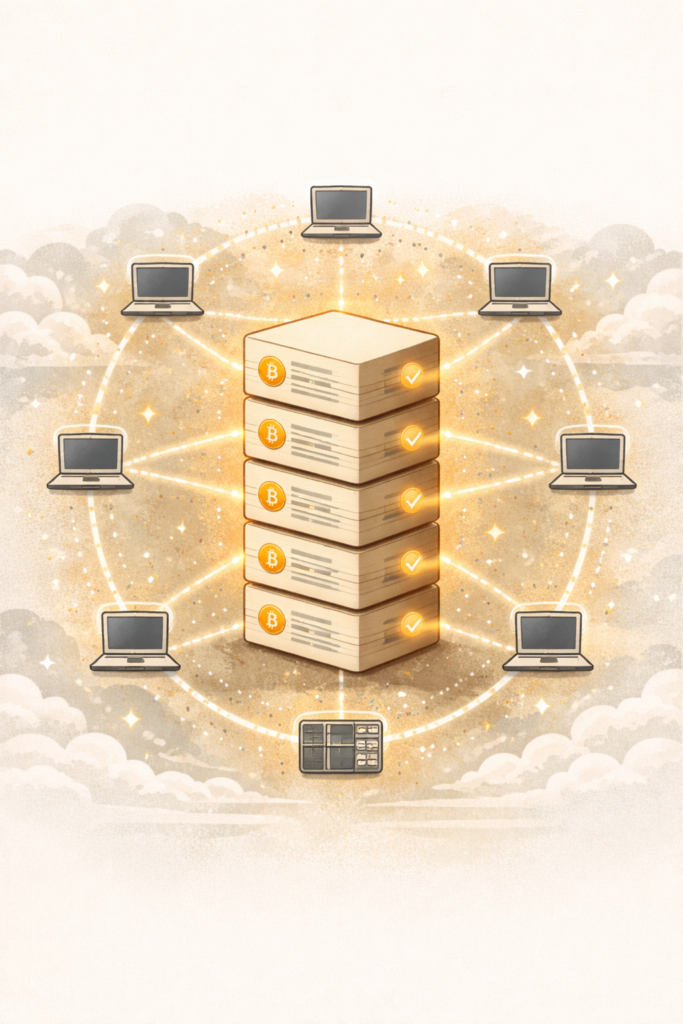
  • Day 2 — Where Did My Bitcoin Actually Go?

    Where a Bitcoin transaction goes

    A Bitcoin transaction does not move a coin like a file. Instead, it changes who has the right to spend bitcoin next.

    That sounds strange at first. However, it becomes simple if you think of Bitcoin as a public record of ownership.

    When you send bitcoin, your wallet creates a signed message. The message says which coins you can spend and where those coins should go next.

    What the wallet actually sends

    Your wallet does three important things. First, it chooses spendable bitcoin linked to your address. Next, it creates a new instruction. Finally, it signs that instruction with your private key.

    The signature proves that the instruction came from someone who controls the right key. It does not reveal the private key itself.

    So the network can check your authority without learning your secret. That is one of the clever parts of Bitcoin.

    How the network checks it

    After the Bitcoin transaction is broadcast, nodes begin checking it. A node asks simple questions.

    • Is the signature valid?
    • Do the coins exist?
    • Were those coins already spent?
    • Does the transaction follow Bitcoin rules?

    If the answer is no, the node rejects the transaction. If the answer is yes, the transaction can move through the network.

    Why nothing “travels”

    In a bank transfer, people often imagine money moving from one account to another. Bitcoin works differently.

    The blockchain records a chain of valid spending rights. A transaction consumes old rights and creates new rights.

    Therefore, the coin is not a moving object. It is a history that proves who may spend value next.

    What miners add

    Miners collect valid transactions and place them into blocks. Then the network checks those blocks too.

    Once a block is accepted, the transaction becomes part of the public history. More blocks after it make that history harder to change.

    This is why confirmations matter. Each confirmation adds more weight behind the transaction.

    A simple takeaway

    A Bitcoin transaction is a signed update to public ownership. Your wallet proposes it. Nodes verify it. Miners package it. Then the blockchain records it.

    So when you ask where your bitcoin went, the answer is clear. It went into a new spendable record on the blockchain.

    That record is public, but control remains private. This balance is what lets Bitcoin work without a bank.