Tag: crypto lending

  • Day 21 — How Can DeFi Lend Money Without a Credit Score?

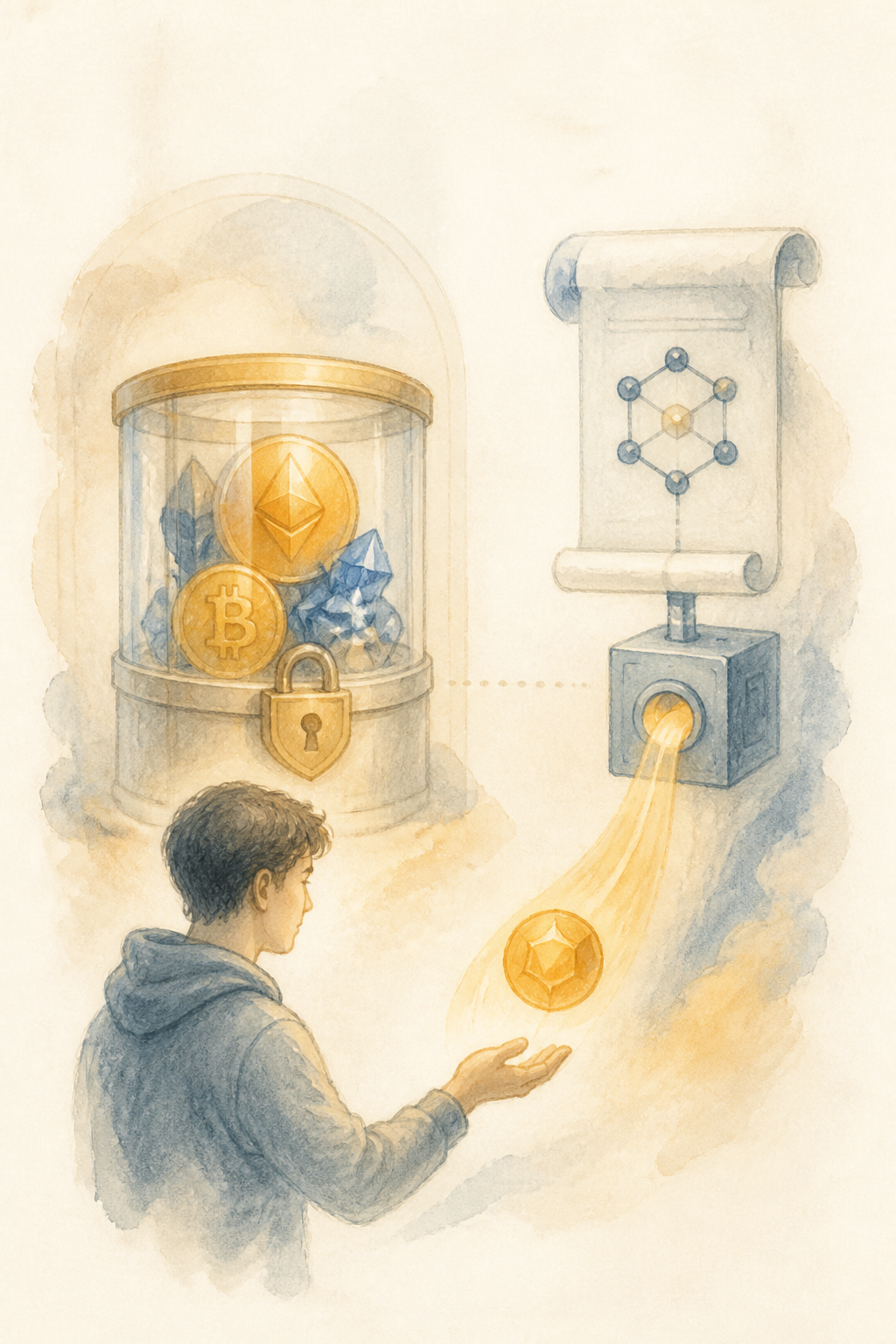
    Watercolor illustration of borrowers and lenders connected through an overcollateralized DeFi lending pool

    A bank can evaluate salary, identity, and repayment history before making a loan. A public blockchain usually does not know those facts. DeFi lending therefore relies on a different protection: borrowers commonly lock collateral worth more than the amount they borrow.

    Lenders deposit assets into a smart-contract pool. Borrowers draw from that shared pool after supplying acceptable collateral. The protocol records deposits, debts, interest, and collateral ratios on-chain, while its rules apply equally to any wallet that can submit a valid transaction.

    Imagine depositing ether worth $1,500 and borrowing $800 in stablecoins. You still benefit if ether rises, and you gain spendable stablecoins without selling it. But if ether falls, the safety margin shrinks. Borrowing the maximum allowed amount leaves very little room for market movement.

    Interest rates are often driven by utilisation. When most of a pool is available, borrowing can be cheap. As more assets are borrowed and liquidity becomes scarce, rates rise to encourage repayment and attract new deposits. The exact curve is code defined by each protocol.

    This system makes loans fast and transparent, but it is not unsecured credit. Overcollateralisation protects lenders precisely because the protocol cannot chase an anonymous borrower later. It also means borrowers already need valuable assets, so DeFi lending does not solve every financial access problem.

    Depositors face risks too: smart-contract bugs, bad collateral, oracle failures, governance changes, and periods when withdrawals are constrained because too much of the pool is borrowed. A displayed supply rate can change rapidly and is not the same as a guaranteed bank deposit.

    If collateral can fall below the safe level, the protocol needs a way to act before the loan becomes undercollateralised. Tomorrow we will examine liquidation—the automatic process that protects the pool but can be painful for borrowers.

  • Day 18 — What Is DeFi If There Is No Bank Behind It?

    Watercolor illustration of open financial services connected through decentralized smart contracts

    Traditional finance organises payments, exchanges, loans, and savings through institutions. Decentralised finance, or DeFi, rebuilds some of those functions with smart contracts on public blockchains. The contracts hold assets and apply rules that users can inspect and invoke with a wallet.

    A DeFi application might let you swap one token for another, lend assets to a shared pool, borrow against collateral, or earn fees by supplying liquidity. There may still be teams, websites, governance groups, and service providers, but the settlement logic and balances are recorded on-chain.

    Its defining feature is open access to the contracts. A compatible wallet can interact without opening a conventional account, and another developer can connect one protocol to another. This composability is often compared to building with money legos: a lending position can become collateral elsewhere, while a trading pool supplies a price or yield source.

    Composability creates efficiency, but also dependency. If one protocol has a bug, a bad price feed, or a failing asset, the effects can travel through every application built on top of it. Transparent code lets anyone inspect the rules, yet it also lets attackers study those rules and search for weaknesses.

    DeFi does not remove intermediaries so much as replace some human discretion with software, incentives, and governance. Users take responsibility for private keys, transaction approvals, network fees, and contract risk. Returns are not protected merely because a dashboard uses the word earn.

    Before depositing, it helps to ask where the return comes from, who can change the contracts, what assets back the position, how withdrawals work, and what happens during a market shock. Audits, long operating history, and diversified risk are useful signals, not guarantees.

    The simplest DeFi action is often a token swap. But without a traditional exchange matching buyers and sellers, who provides the other side of that trade? Tomorrow we will unpack the automated market maker.