Tag: defi

  • Day 20 — Why Would Anyone Put Their Tokens Into a Liquidity Pool?

    Watercolor illustration of liquidity providers adding a pair of tokens to a shared trading pool

    An automated market maker cannot serve traders with an empty pool. The assets are supplied by liquidity providers, often called LPs. They deposit a pair of tokens into a smart contract so other people can swap between them.

    Suppose a pool holds ether and a stablecoin. A provider contributes both assets at the pool’s current value ratio and receives a token or accounting record representing a percentage of the pool. If the provider owns one percent of the pool, that claim grows or shrinks with the pool’s reserves.

    Every swap usually pays a small fee. The fee remains in the pool or is distributed according to the protocol’s design, giving LPs a reason to provide capital. More liquidity also benefits traders by reducing slippage, so a healthy market tries to balance useful depth with a fair return for providers.

    The catch is that the pool constantly rebalances the two assets as prices move. If ether rises sharply, arbitrage traders remove ether from the pool and add stablecoins until the pool matches the outside price. The LP ends up holding less of the asset that rose and more of the asset that lagged.

    Compared with simply holding both tokens, this difference is called impermanent loss. The name can be misleading: if the provider withdraws while prices are far apart, the loss relative to holding becomes real. Trading fees may offset it, but they are not guaranteed to do so.

    LPs also face smart-contract bugs, malicious tokens, oracle or bridge failures in some designs, and the possibility that an incentive token loses value. A high advertised annual return says little unless we know the trading volume, fee income, price risk, and source of extra rewards.

    Liquidity provision turns passive assets into market infrastructure, with rewards tied to real risks. Another kind of pool uses deposits not for swaps but for loans. Tomorrow we will see how lending can work without a bank checking your credit score.


  • Day 19 — How Can You Trade Without an Order Book?

    Watercolor illustration of an automated market maker balancing two token reserves in a liquidity pool

    A traditional exchange keeps an order book: buyers state the price they will pay, sellers state the price they will accept, and the exchange matches them. Many decentralised exchanges use a different machine called an automated market maker, or AMM.

    An AMM stores two assets in a smart contract called a liquidity pool. Imagine a pool containing ether and a stablecoin. A trader who wants ether adds stablecoins to the pool and removes some ether. The contract calculates the amount using a mathematical rule instead of waiting for a specific seller.

    A common simplified rule is x multiplied by y equals k. Here x and y are the quantities of the two assets, while k should remain roughly constant after a trade, before fees. When ether becomes scarcer in the pool, the formula makes each additional unit more expensive. The pool’s ratio therefore moves as people trade.

    The displayed price is not an opinion formed by the contract. It emerges from the current reserves. If the AMM price differs from larger markets, arbitrage traders buy from the cheaper place and sell to the expensive one. Their transactions push the pool back toward the wider market price.

    Large trades move the reserve ratio more than small trades. The difference between the expected price and the executed price is called slippage. Deep pools usually produce lower slippage, while a thin pool can move dramatically from a modest transaction. Slippage limits protect users from accepting a much worse result than expected.

    AMMs make always-available on-chain trading possible, but their contracts, tokens, and pools still carry risk. A fake token can use a familiar symbol, a pool can be too shallow to exit safely, and a poorly chosen slippage setting can invite manipulation or failed transactions.

    The pool clearly needs assets before anyone can trade. Tomorrow we will meet the liquidity providers who deposit those assets, collect fees, and take on a less obvious risk called impermanent loss.

  • Day 18 — What Is DeFi If There Is No Bank Behind It?

    Watercolor illustration of open financial services connected through decentralized smart contracts

    Traditional finance organises payments, exchanges, loans, and savings through institutions. Decentralised finance, or DeFi, rebuilds some of those functions with smart contracts on public blockchains. The contracts hold assets and apply rules that users can inspect and invoke with a wallet.

    A DeFi application might let you swap one token for another, lend assets to a shared pool, borrow against collateral, or earn fees by supplying liquidity. There may still be teams, websites, governance groups, and service providers, but the settlement logic and balances are recorded on-chain.

    Its defining feature is open access to the contracts. A compatible wallet can interact without opening a conventional account, and another developer can connect one protocol to another. This composability is often compared to building with money legos: a lending position can become collateral elsewhere, while a trading pool supplies a price or yield source.

    Composability creates efficiency, but also dependency. If one protocol has a bug, a bad price feed, or a failing asset, the effects can travel through every application built on top of it. Transparent code lets anyone inspect the rules, yet it also lets attackers study those rules and search for weaknesses.

    DeFi does not remove intermediaries so much as replace some human discretion with software, incentives, and governance. Users take responsibility for private keys, transaction approvals, network fees, and contract risk. Returns are not protected merely because a dashboard uses the word earn.

    Before depositing, it helps to ask where the return comes from, who can change the contracts, what assets back the position, how withdrawals work, and what happens during a market shock. Audits, long operating history, and diversified risk are useful signals, not guarantees.

    The simplest DeFi action is often a token swap. But without a traditional exchange matching buyers and sellers, who provides the other side of that trade? Tomorrow we will unpack the automated market maker.

  • Day 17 — What Keeps a Stablecoin Stable?

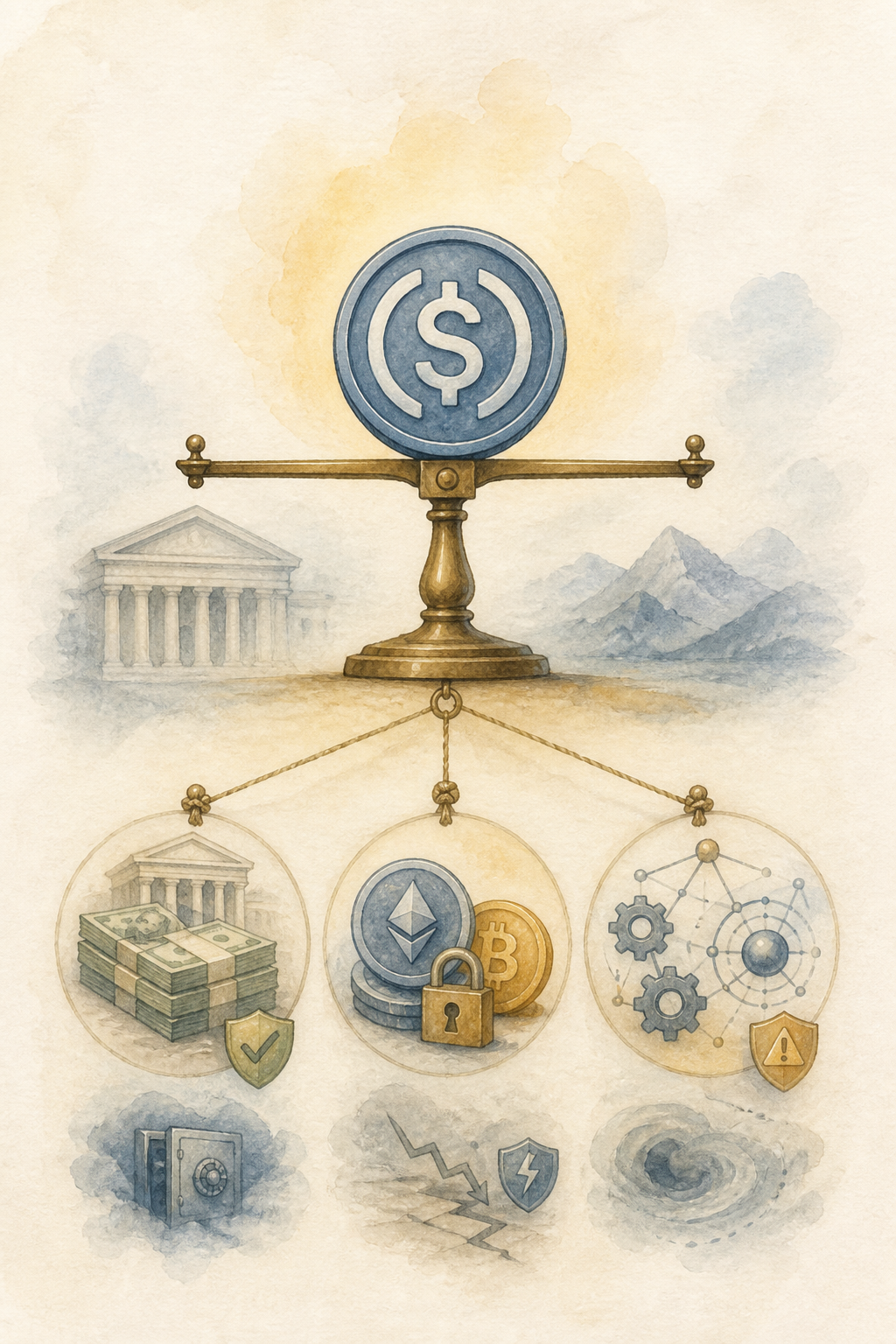
    Watercolor illustration of a stablecoin balancing different forms of collateral around a price peg

    Bitcoin and ether can change price sharply within a day. That volatility makes them difficult to use as a unit of account or short-term parking place. Stablecoins attempt to solve this by targeting a steady reference price, most commonly one US dollar.

    The word stable describes a goal, not a guarantee. A stablecoin needs a mechanism that encourages its market price to return to the peg. The mechanism differs by design, and understanding it is more useful than trusting the name printed on the token.

    Fiat-backed stablecoins are issued against assets held by a company or custodian. In the ideal case, one token can be redeemed for one dollar, and traders buy or sell when the market price drifts. Users depend on the issuer, its banks, the quality of reserves, redemption rules, and the accuracy of public reports.

    Crypto-collateralised stablecoins use assets locked in smart contracts. Because crypto prices move, these systems normally require collateral worth more than the stablecoins created. If collateral falls too far, it can be liquidated to protect the system. This design is transparent on-chain but still exposed to market, oracle, and contract risks.

    Algorithmic designs try to manage supply using incentives or a related token, sometimes with little dependable collateral. They can appear efficient during calm markets, yet confidence can unravel quickly. If everyone wants to exit at once and the promised redemption value is not available, the feedback loop can break the peg.

    Stablecoins also differ in censorship controls, chain support, liquidity, legal claims, and technical bridges. Two tokens both trading near one dollar can therefore carry very different risks. It is worth checking the issuer, reserves, redemption path, contract permissions, and the network version you actually hold.

    Stablecoins became a basic building block for on-chain trading, borrowing, and payments. Tomorrow we will explore the larger system built from these pieces: decentralised finance, usually shortened to DeFi.