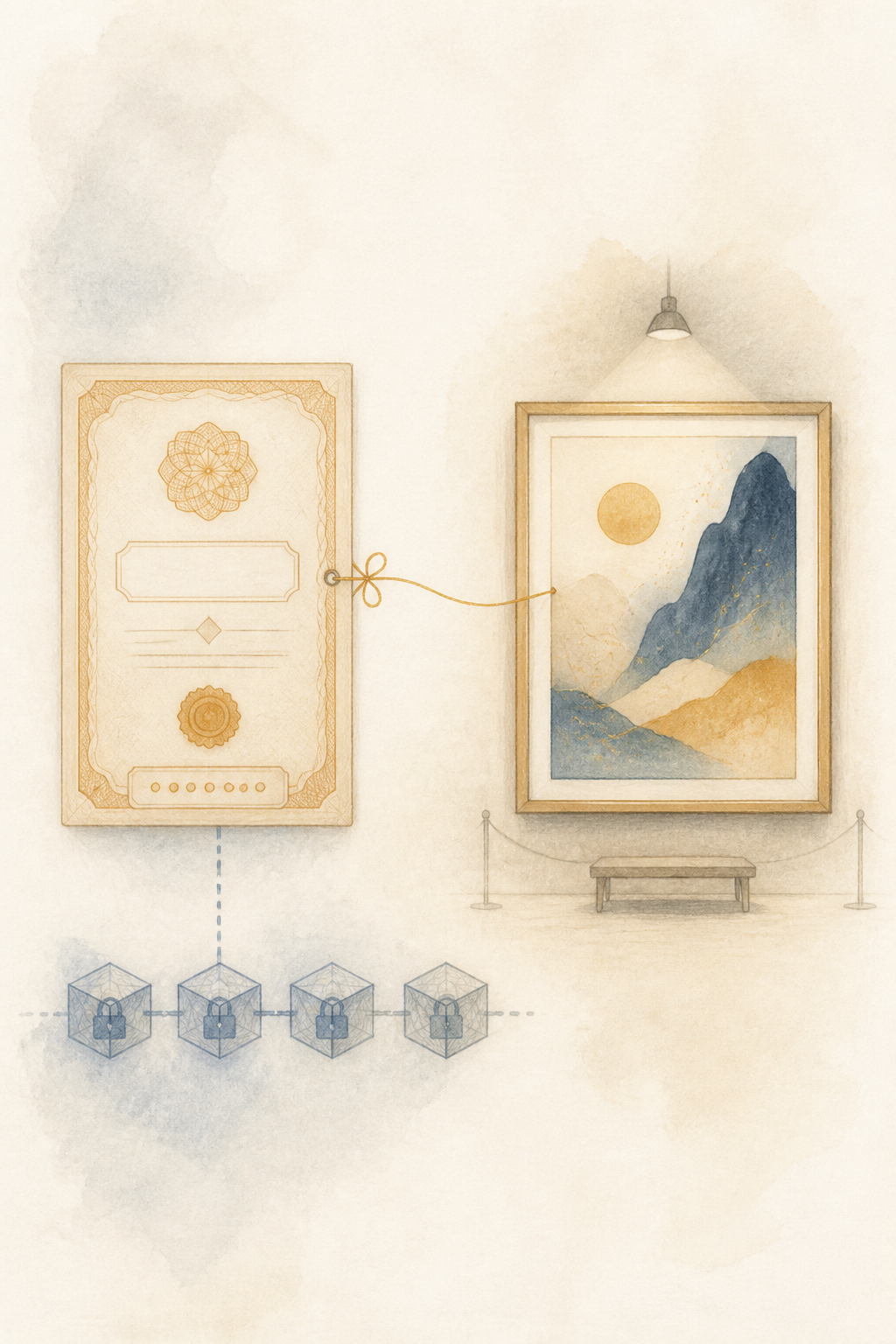
An ordinary token is designed so that one unit can replace another. An NFT does the opposite: it gives each item a distinct identity. NFT stands for non-fungible token, and its most important feature is usually a unique token ID recorded by a smart contract.
Think of cinema tickets. Two tickets may have the same price, but seat A1 is not the same as seat F12. An NFT contract can record that wallet 0xABC owns token number 42, while another wallet owns token number 43. Transferring the NFT updates that ownership record on the blockchain.
The artwork, video, or document associated with an NFT is often not stored directly on Ethereum because large files are expensive to keep on-chain. The token usually points to metadata, and that metadata may point to a file on IPFS or a conventional server. This distinction matters: the blockchain can preserve the ownership record while the linked media may still depend on outside storage.
Owning an NFT also does not automatically mean owning the copyright. A token can prove that a wallet controls a particular on-chain item, but intellectual-property rights depend on the licence or agreement provided by the creator. Buying a digital collectible is not necessarily permission to reproduce its artwork commercially.
NFTs can represent more than profile pictures. They can act as event tickets, game items, membership passes, certificates, or records tied to physical goods. Whether blockchain adds value depends on whether public transferability and shared verification are actually useful for that case.
The risks are familiar but easy to overlook: copied artwork, misleading collections, malicious approvals, changing metadata, and thin markets. A visible image is not proof of authenticity. Users should verify the contract address, collection history, storage method, and permissions they are signing.
A token can therefore become a portable piece of state that many applications recognise. Tomorrow, let us examine those applications themselves: what makes a dApp decentralised when its website can still look completely ordinary?