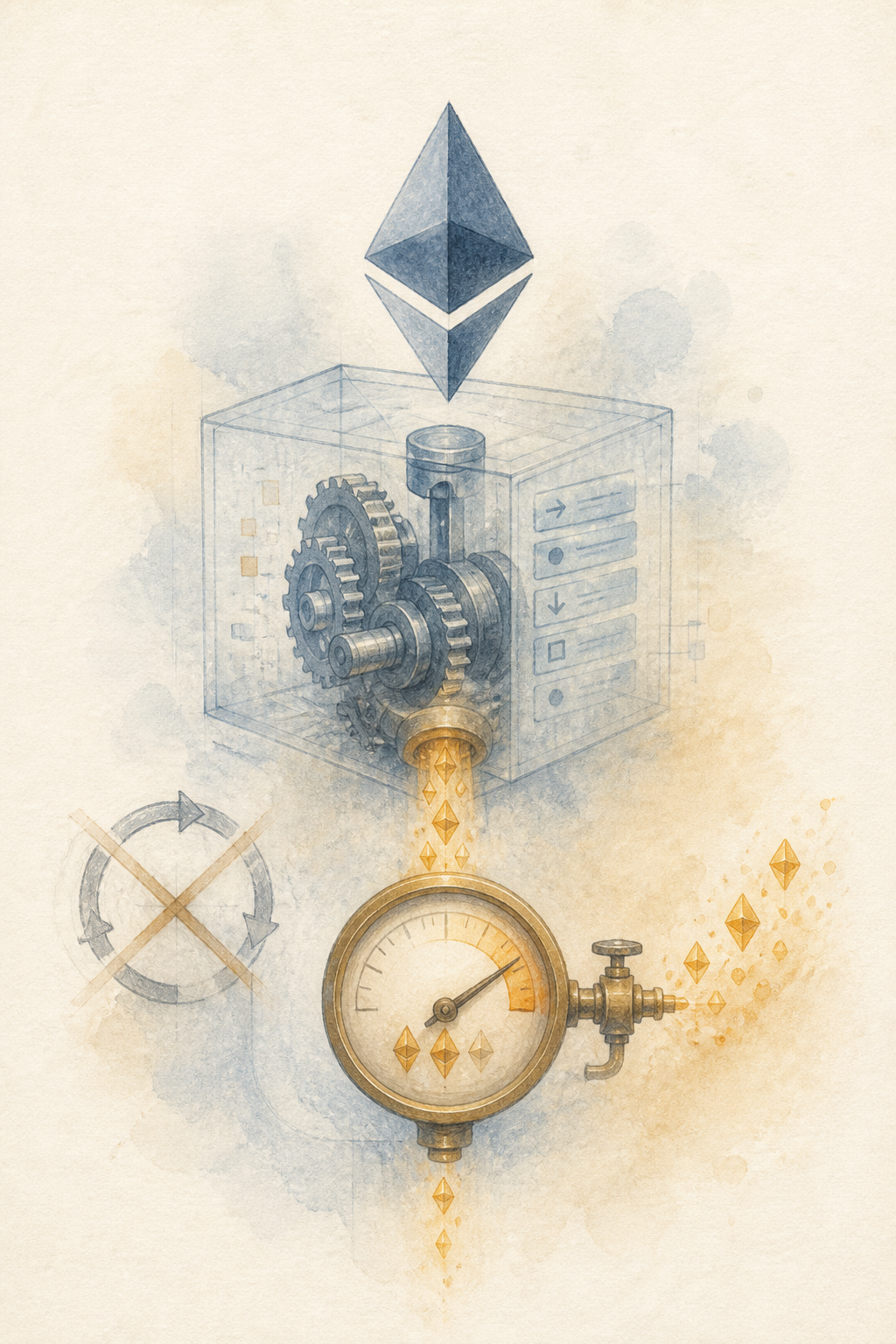
A dashboard may promise five, twenty, or even one hundred percent annual yield, but the percentage is the last part of the story. The first question should be: who is paying, and what useful activity produces the return?
In a lending market, yield can come from interest paid by borrowers. In a liquidity pool, it can come from fees paid by traders. Proof-of-stake networks reward validators for helping secure and operate the chain, and some of those rewards can flow to people who delegate or stake assets.
Protocols also distribute newly created tokens to attract users. These incentives can bootstrap a market, but they are not the same as durable revenue. If everyone earns a token only to sell it, and there is no continuing demand for it, the displayed yield may collapse along with the token price.
Annual percentage yield often assumes rewards are reinvested and the current rate continues for a full year. Both assumptions can be unrealistic. Rates change with utilisation, trading volume, token emissions, and market prices. A high APY can disappear within hours while the underlying asset falls much faster.
Yield is compensation for something: lending risk, market-making risk, price volatility, lock-up, validator penalties, smart-contract exposure, or simple token dilution. If the source cannot be explained clearly, the return may be circular—paid mainly from new deposits or newly printed incentives rather than productive demand.
A useful review separates rewards by source, values them in a stable unit, checks withdrawal conditions, and tests what happens if the reward token drops sharply. It also includes gas, slippage, taxes, and impermanent loss instead of focusing only on the largest number on the screen.
Many yield protocols can change parameters or direct a treasury through community voting. Tomorrow we will look at the organisation behind that process: the DAO, and how decentralised its decisions really are.
Blockchains are good at agreeing about information already inside their own system. Every node can verify a signature, a balance, or the result of contract code. But a smart contract cannot simply open a news website and ask for today’s gold price.
That restriction is deliberate. If thousands of nodes fetched a web page independently, they might receive different answers because of timing, location, or a changed server response. The network would no longer have one deterministic result. Smart contracts therefore need data to be delivered to them in a form the blockchain can agree on.
An oracle is the bridge that supplies this outside information. It can publish asset prices, weather measurements, sports results, proof of reserves, or other facts. A DeFi lending market, for example, may use an oracle price to decide how much a borrower’s collateral is worth.
A single data source creates a dangerous point of failure. If it is wrong, delayed, hacked, or manipulated, the contract may execute perfectly using bad information. Decentralised oracle networks try to reduce this risk by collecting reports from multiple providers and combining them according to transparent rules.
Even then, the oracle problem does not disappear. Someone must decide which sources count, how often updates occur, what happens during extreme markets, and how disputes are handled. The security of an application is only as strong as the data and assumptions on which its contracts depend.
Oracle failures can be expensive because blockchain actions are difficult to reverse. Attackers have manipulated thin-market prices, borrowed against inflated collateral, and drained protocols before prices returned to normal. Sensible designs use several sources, time-weighted prices, update limits, and emergency controls.
Oracles make real-world financial products possible on-chain. One widely used product is a token designed to follow a familiar price, usually one US dollar. Tomorrow we will ask what actually keeps a stablecoin stable.
An ordinary token is designed so that one unit can replace another. An NFT does the opposite: it gives each item a distinct identity. NFT stands for non-fungible token, and its most important feature is usually a unique token ID recorded by a smart contract.
Think of cinema tickets. Two tickets may have the same price, but seat A1 is not the same as seat F12. An NFT contract can record that wallet 0xABC owns token number 42, while another wallet owns token number 43. Transferring the NFT updates that ownership record on the blockchain.
The artwork, video, or document associated with an NFT is often not stored directly on Ethereum because large files are expensive to keep on-chain. The token usually points to metadata, and that metadata may point to a file on IPFS or a conventional server. This distinction matters: the blockchain can preserve the ownership record while the linked media may still depend on outside storage.
Owning an NFT also does not automatically mean owning the copyright. A token can prove that a wallet controls a particular on-chain item, but intellectual-property rights depend on the licence or agreement provided by the creator. Buying a digital collectible is not necessarily permission to reproduce its artwork commercially.
NFTs can represent more than profile pictures. They can act as event tickets, game items, membership passes, certificates, or records tied to physical goods. Whether blockchain adds value depends on whether public transferability and shared verification are actually useful for that case.
The risks are familiar but easy to overlook: copied artwork, misleading collections, malicious approvals, changing metadata, and thin markets. A visible image is not proof of authenticity. Users should verify the contract address, collection history, storage method, and permissions they are signing.
A token can therefore become a portable piece of state that many applications recognise. Tomorrow, let us examine those applications themselves: what makes a dApp decentralised when its website can still look completely ordinary?
Open a crypto wallet and you may see ether, stablecoins, governance tokens, and dozens of other assets. It is natural to assume that every token runs on its own blockchain. In reality, many of them are programs living on an existing network such as Ethereum.
A token is usually a smart contract that maintains a ledger. The contract records how many units each address owns and contains rules for transferring those units. When Priya sends ten tokens to Arjun, no separate coin travels through the internet. Ethereum executes the token contract, subtracts ten from Priya’s recorded balance, and adds ten to Arjun’s.
Most fungible Ethereum tokens follow a common interface called ERC-20. It specifies familiar actions such as checking a balance, transferring tokens, and allowing another contract to spend a limited amount. Because wallets and exchanges understand the same interface, a newly created token can be displayed and handled without every application learning an entirely new language.
Fungible means one unit is intended to be interchangeable with another, like one ₹10 coin for another ₹10 coin. Such tokens can represent voting power, access to a service, a claim on collateral, or simply a speculative asset. The code defines the mechanics, but it does not guarantee that the story or value behind the token is genuine.
Creating a token is easy; trusting one is not. Two tokens may share the same name and symbol, so the contract address is the reliable identifier. Before interacting, it is worth checking who can mint more supply, pause transfers, blacklist addresses, or upgrade the contract. Those permissions can matter more than the logo.
Token transfers also use the underlying network. On Ethereum, users still need ether to pay gas even when they are sending a different token. The token depends on Ethereum for ordering, security, and execution; it is not an independent blockchain.
But what if every unit should not be identical? Tomorrow we will look at NFTs, where ownership is tracked by a unique token ID rather than only by a quantity.
We now know that Ethereum nodes repeat the instructions inside a smart contract so that the network can agree on one result. That shared execution creates a new problem. Computation is not free. If anybody could ask every node to perform unlimited work, a careless program or an attacker could keep the network busy forever.
Ethereum solves this with gas. Gas is a unit used to measure the amount of computational work a transaction requires. Adding two numbers costs a small amount. Reading or changing stored data costs more. Deploying a large smart contract may require much more. Gas is not a separate coin; it is the meter that counts the work, while the fee is paid in ether.
Think of it like taking a taxi. Distance is not money, but it helps calculate the fare. In the same way, gas measures the journey through a program. A user sets a limit on how much gas the transaction may consume. If the contract finishes within that limit, unused capacity is not charged. If it runs out, execution stops so that the program cannot consume resources endlessly.
The final fee also depends on what the network is charging for each unit of gas. When many people want their transactions included, block space becomes more competitive and fees can rise. A user can also offer an additional priority fee to encourage faster inclusion. This is why two identical actions performed at different times may cost different amounts.
Gas protects the network, but it can surprise beginners. A transaction that fails may still consume a fee because nodes already performed work before discovering the failure. Paying for computation does not guarantee that the intended result will succeed; it pays the network for checking and executing the attempt.
This system turns computation into a scarce resource and discourages spam. It also explains why developers try to write efficient contracts and why scaling Ethereum matters so much. Before we reach scaling, however, we need to understand who is authorising these paid instructions.
When a website sees a password, it asks a company’s server whether the password is correct. Ethereum has no such account desk. So how can a wallet prove that a transaction truly came from you without sending a password to the network? The answer lies in digital signatures.
Yesterday we described Ethereum as a blockchain that can hold both value and logic. That description sounds impressive, but it also hides a practical problem. A program cannot execute itself. On a normal website, code runs on a server owned by a company. If Ethereum has no central server, which computer actually runs a smart contract?
The answer is not one special machine. Ethereum defines a small, standardised computing environment called the Ethereum Virtual Machine, usually shortened to the EVM. Developers write smart contracts and compile them into instructions that the EVM understands. Those instructions are stored on the blockchain along with the contract’s address and data.
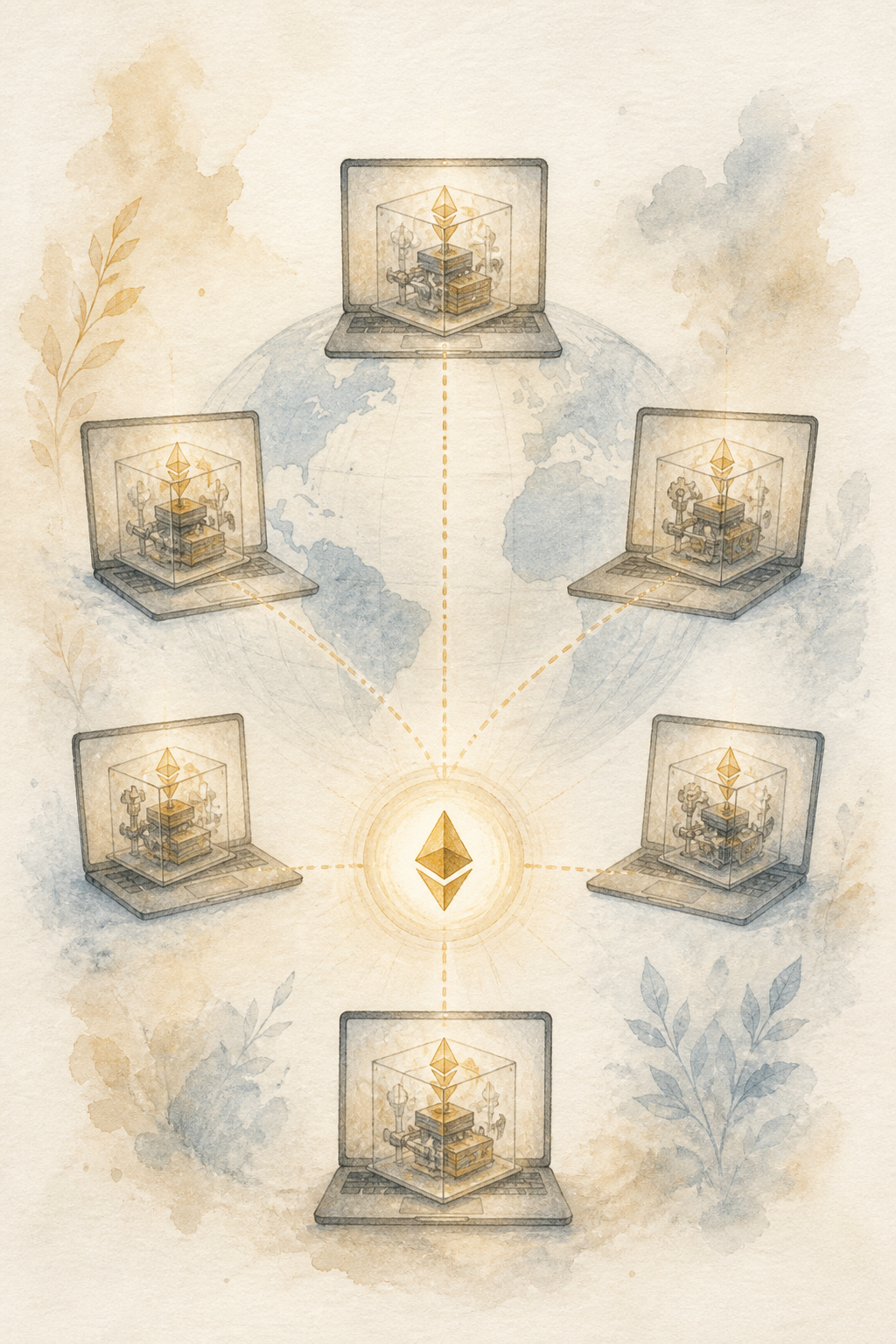
A useful way to imagine the EVM is as a calculator whose design has been copied onto thousands of computers. Give every copy the same starting numbers and the same operation, and each should produce the same answer. When someone sends a transaction to a smart contract, Ethereum nodes execute the relevant instructions and calculate the resulting changes. One node may be in Mumbai and another in London, but the rules of the virtual machine are the same.
The result is a shared state. This state includes account balances, contract storage and other information that Ethereum currently recognises as true. A transaction proposes a change to that state. The network checks the signature, executes the contract, and agrees on the new result before it becomes part of a block. A person cannot simply change the answer on their own computer because their version would disagree with everyone following the protocol.
For this agreement to work, the EVM has to be deterministic. The same input must always lead to the same output. A smart contract therefore cannot casually ask one computer for its local time, read a private file, or browse a website while it is running. Different machines might receive different answers. Contracts operate inside a controlled sandbox and can use only information supplied in a form the network can verify.
This repetition sounds wasteful because many computers perform the same work. In one sense it is. Ethereum deliberately trades ordinary server efficiency for independent verification. The benefit is that no single server owner can secretly change the program’s result, switch off the database or rewrite a balance. The cost is that shared computation is scarce.
That leads to the next question. If thousands of machines may need to check a computation, what prevents someone from submitting an enormous program or an infinite loop and making everybody work for free? Ethereum’s answer is a meter attached to every instruction: gas.
Yesterday, we reached a boundary in Bitcoin’s design. Bitcoin is exceptionally good at recording ownership and moving value without a bank, but its rules are deliberately narrow. It can answer questions such as “Does this person own these coins?” and “Has this money already been spent?” What if a blockchain could answer a more interesting question: “Should this money move only when a particular condition becomes true?”
Imagine that you and your friend Rahul make a small bet on a cricket match. Ordinarily, one of you would hold the money, or both of you would trust a third person to pay the winner. That third person could disappear, take a fee, choose a side, or simply make a mistake. Now imagine placing the money inside a transparent digital box. The box contains a rule: after the match ends, release the entire amount to whoever won. Nobody can quietly change the rule, and the box does not need to like or trust either person.
This is the basic idea behind a smart contract. A smart contract is a small program stored on a blockchain. It receives information, checks the rules written into its code, and changes the blockchain’s state when those rules are satisfied. It can hold digital assets, send them, exchange them, or record a result. Once deployed, the same program is visible to the network and every participant can verify what it is supposed to do.
The name can be slightly misleading. A smart contract is not necessarily smart, and it is not automatically a legal contract. It does not understand intention, fairness, or the spirit of an agreement. It follows instructions. If the code says that money should move after a certain digital signature appears, then that is the condition it checks. It behaves less like a lawyer and more like a vending machine: provide the required input, and a predictable output follows.
Bitcoin already has a limited scripting system, but it was intentionally designed to remain simple and cautious. In 2015, Ethereum took a broader approach. Instead of building a blockchain mainly around one kind of digital asset, Ethereum was designed as a shared platform on which developers could publish many different programs. Its native currency, ether, is used to pay for activity on this network, but the larger idea is that the blockchain can store both value and logic.
That small change opens a surprisingly large door. A lending program can release funds when enough collateral has been deposited. A marketplace can exchange a token and a payment in one operation so that neither side has to move first. A group can keep funds in a shared treasury that only moves after several members approve. A game can record ownership of an item outside the company that created it. Each of these systems can be built from smart contracts that interact with one another.
Applications built in this manner are usually called decentralized applications, or dApps. They may still look like ordinary websites on the surface. There can be buttons, forms, profiles and colourful dashboards. The difference lies underneath. Instead of sending every important instruction to one company’s private server, the application sends transactions to smart contracts on a public network. The rules and resulting changes can be independently checked.
This does not remove trust completely. It changes where trust is placed. Users no longer need to trust a company to follow hidden database rules, but they must trust that the public code was written correctly. A mistake in an ordinary website can often be repaired quietly by an administrator. A mistake in a smart contract can be much harder to undo, particularly if the program controls valuable assets. Transparency helps people inspect the rules, but visible code is not the same as flawless code.
There is another puzzle. If a smart contract is a program, some computer must run it. A normal application usually has a server owned by one company. Ethereum claims to run programs without giving one server or one company control. Does every computer execute every instruction? Who decides the result, and what prevents someone from changing it on their own machine?
To answer that, we need to look inside Ethereum’s shared computer: the Ethereum Virtual Machine.