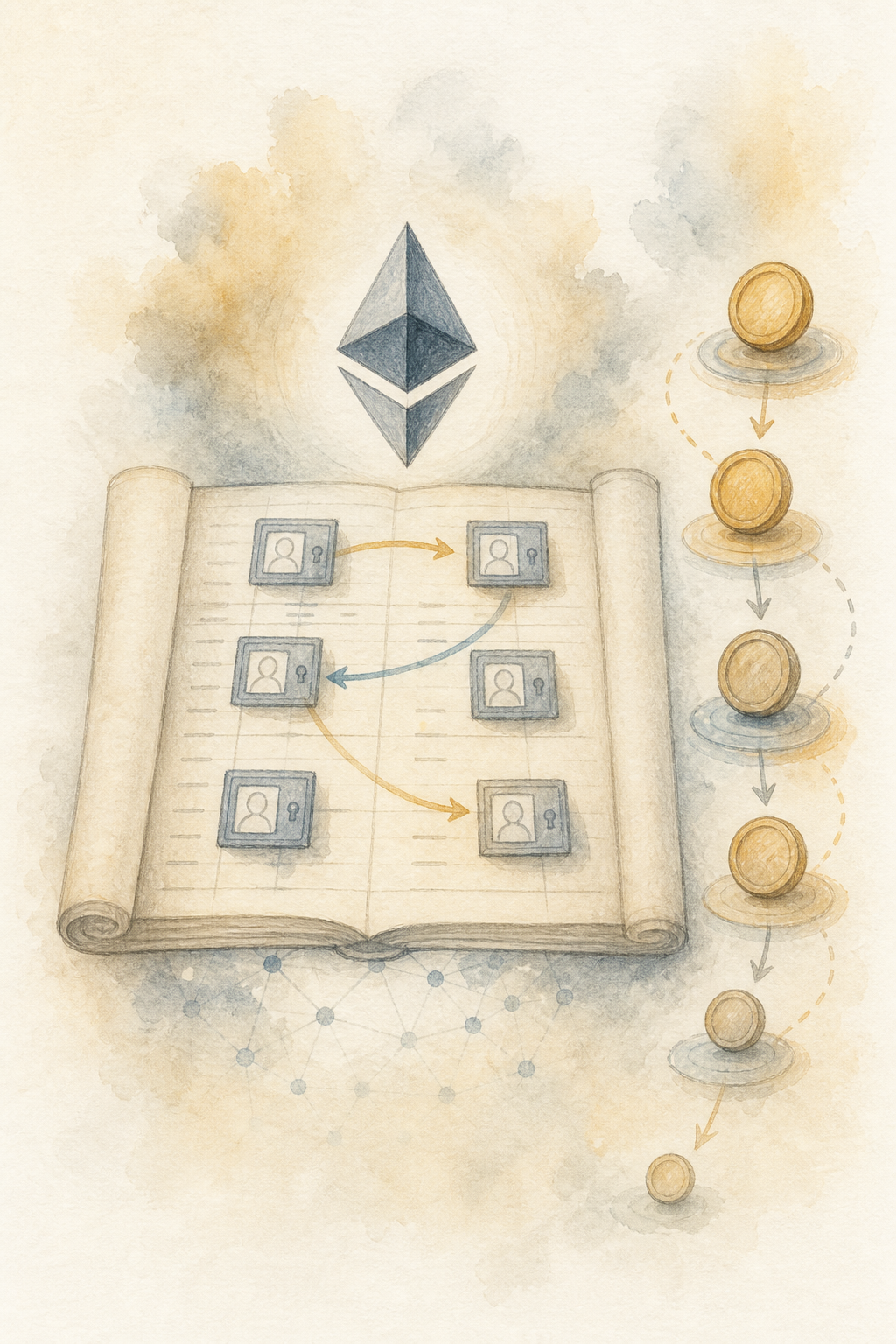
Bitcoin and Ethereum both move value, but they keep score in very different ways. Bitcoin uses unspent transaction outputs, usually called UTXOs. You can imagine them as digital notes in your wallet: if you own a ₹500 note and want to pay ₹300, the whole note is spent and a new ₹200 note comes back as change.
Ethereum uses an account-based model. Instead of tracking separate notes, the network maintains a shared map of accounts and their current state. An account can hold ether, and the balance changes when a valid transaction is processed. This feels closer to a bank ledger, although no bank controls the ledger.
There are two main kinds of Ethereum accounts. An externally owned account is controlled by a private key—the kind your wallet creates for you. A contract account is controlled by code deployed on Ethereum. Both have addresses and can hold ether, but only an externally owned account can begin a transaction by signing it.
An externally owned account stores a balance and a nonce. The nonce counts how many transactions that account has sent, which helps the network reject replayed or duplicated transactions. A contract account can additionally hold code and persistent storage, allowing it to remember rules, balances, votes, loans, or almost any other structured state.
Suppose Rahul sends one ether to Sneha. Ethereum does not search for a uniquely numbered coin and move it. Validators check Rahul’s signature, balance, nonce, and gas, then reduce Rahul’s balance and increase Sneha’s. Every node applies the same state transition and arrives at the same updated ledger.
This model makes smart contracts practical. A lending contract can remember deposits and debts; a game can remember who owns an item; a token contract can maintain thousands of balances. The trade-off is that this growing shared state must be stored and verified by the network, so storage is deliberately expensive.
That leads to a surprising question for tomorrow: if your wallet shows ten different tokens, are those ten separate blockchains—or are they entries inside smart contracts on Ethereum?